








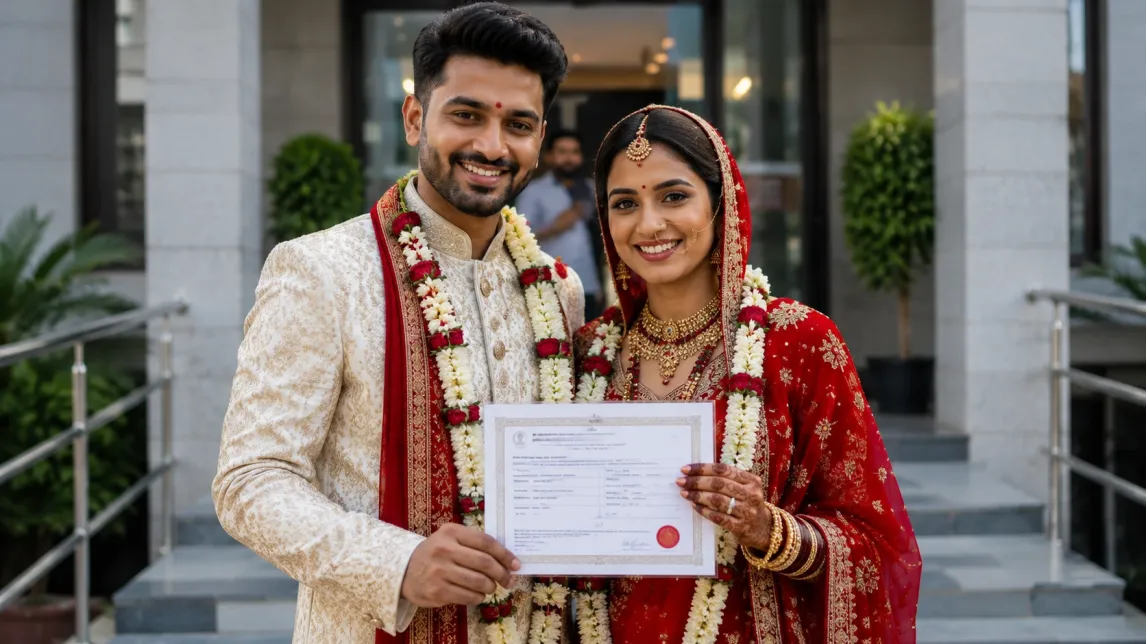
Marriage is certainly a landmark event, but so is its registration. While customary wedding rituals enjoy social and cultural significance, getting registered means that your marriage will receive legal status. The marriage registration certificate is an officially issued document which serves as evidence of marriage and comes handy when it comes to visa application, passport changes, nomination in banks, insurance claims, property matters, and so forth.
Couples in India are allowed to get their marriage registered according to the Hindu Marriage Act of 1955 and Special Marriage Act of 1954. The actual process may somewhat differ from one state to another, but generally speaking, the procedure is more or less the same across the country.
The guide describes the entire marriage registration process in India. The eligibility requirements, necessary documentation, relevant legislation, and detailed procedure will be outlined below.
Why Is Marriage Registration Important ?
When you get your soulmate through an online matrimonial platform, most couples feel that having a traditional wedding ceremony alone is enough. But when you get the marriage certificate of registration through law, it means that your marriage is legally recognized.
A registered marriage makes things easy for you in many ways. You can register and get a marriage certificate through our online portal.
Benefits of Marriage Registration
A valid marriage registration helps you:
- Obtain legal proof of marriage.
- Apply for passports and visas.
- Update government records.
- Complete bank and insurance nominations.
- Handle property and inheritance matters.
- Access various government and legal services.
It also provides greater legal protection in case of disputes or other legal proceedings.
Marriage Registration Laws in India
The law under which you register depends on your religion and the type of marriage. India primarily recognizes two important laws for marriage registration in India.
Hindu Marriage Act, 1955
The Hindu Marriage Act applies to:
- Hindus
- Buddhists
- Jains
- Sikhs
If your marriage has already been performed according to traditional religious customs, it can generally be registered under this Act, subject to state rules.
Special Marriage Act, 1954
The Special Marriage Act is commonly used when:
- Couples belong to different religions.
- Couples prefer a civil marriage.
- The marriage is solemnized before the Marriage Registrar.
The Act provides a legal framework for marriages irrespective of religion while ensuring legal recognition throughout India.
Eligibility for Marriage Registration
Before applying for online marriage registration or visiting the Marriage Registrar's office, both partners must satisfy certain eligibility conditions.
Basic Eligibility Criteria
Generally, the following conditions apply:
- The groom must have completed 21 years of age.
- The bride must have completed 18 years of age.
- Both individuals must give free and valid consent.
- Neither spouse should have a living husband or wife at the time of marriage, unless legally permitted.
- The marriage should comply with the applicable marriage laws.
Some states may have additional procedural requirements, so applicants should verify the latest rules with their respective authorities.
Required Documents for Marriage Registration
Preparing your documents in advance helps avoid unnecessary delays during the marriage registration process. Although document requirements may vary slightly across states, most authorities ask for similar records.
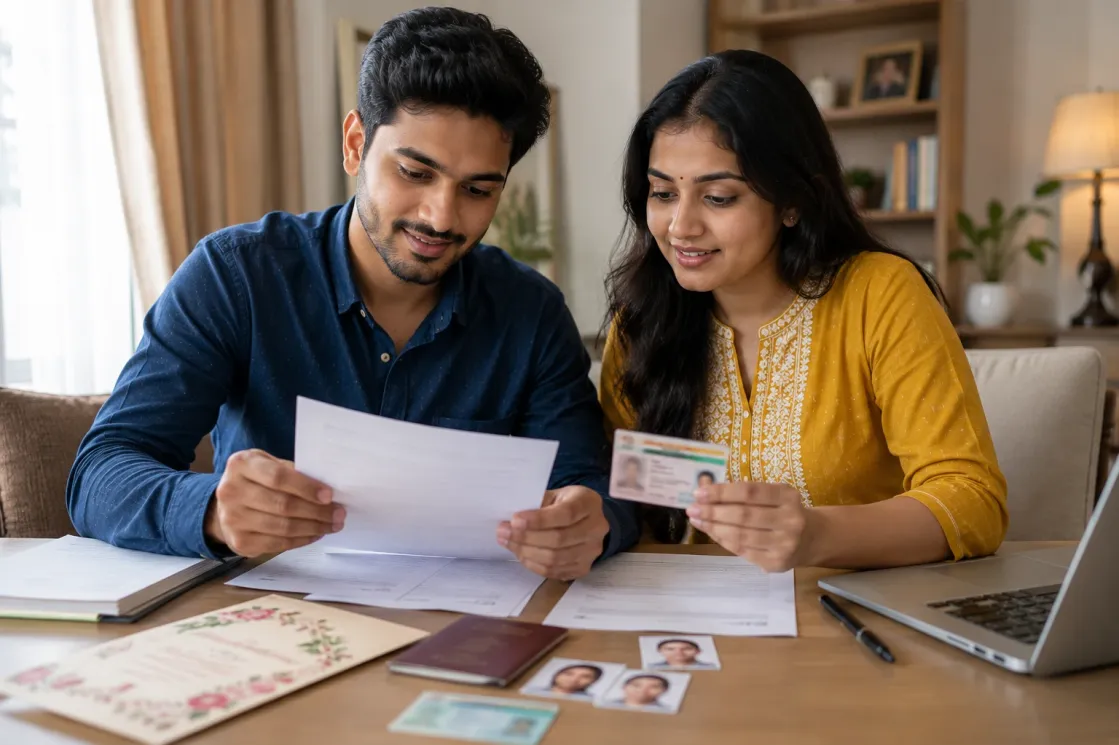
Common Documents Required
Generally, applicants need:
- Aadhaar Card
- PAN Card
- Passport-size photographs
- Wedding invitation card (where applicable)
- Marriage photographs
- Age proof
- Address proof
- Identity proof
- Affidavit declaring marital status
- Proof of marriage ceremony
- Witness identity documents
The required documents for marriage registration should always be verified on your respective state government's official website before applying.
Step-by-Step Marriage Registration Process
Understanding the complete marriage registration procedure makes the application process much easier.
Although some states have fully digital services while others follow a hybrid process, the overall steps remain similar.
Step 1 – Gather Your Documents
Collect all required documents before beginning your application.
Ensure that:
- Names are consistent across all documents.
- Address proofs are valid.
- Photographs are recent.
- Identity documents are not expired.
Preparing everything beforehand helps speed up the registration process.
Step 2 – Complete the Marriage Registration Application
Most states now offer an online marriage registration facility through their official government portals.
Applicants usually need to:
- Fill out the application form.
- Upload supporting documents.
- Enter personal details.
- Provide marriage details.
- Select the appropriate registration office.
In states where online services are unavailable, applications can usually be submitted directly at the marriage registration office.
Step 3 – Schedule an Appointment
After submitting the marriage registration application, applicants may receive an appointment date for document verification.
On the scheduled day, both spouses generally need to appear before the Marriage Registrar along with the required witnesses and original documents.
Carrying all original records helps avoid unnecessary delays during verification.
Common Mistakes to Avoid During Marriage Registration
Many applications are delayed because of simple errors that can easily be prevented.
Avoid These Mistakes
Do not:
- Submit incomplete documents.
- Upload unclear photographs.
- Use mismatched names across documents.
- Forget witness identity proofs.
- Ignore appointment dates.
- Submit incorrect personal information.
Carefully reviewing your application before submission can save considerable time and effort.
Step 4 – Document Verification and Witnesses
After applying for the marriage registration, the two parties are expected to attend an interview with the Marriage Registrar on the assigned day. At this point, the submitted documents are examined, and the information stated in the application is checked.
It should be ensured by the registrar that the marriage meets the legal requirements according to the law.
Role of Witnesses
Witnesses play an important role in the marriage registration process. Their presence confirms that the marriage has taken place and that the information provided is genuine.
Generally, witnesses should:
- Be adults (18 years or above).
- Carry valid government-issued identity proof.
- Be present during verification if required by the local authority.
The number of witnesses may vary depending on the applicable Act and state regulations. Always check the latest requirements with your local marriage registration office.
Step 5 – Issuance of the Marriage Registration Certificate
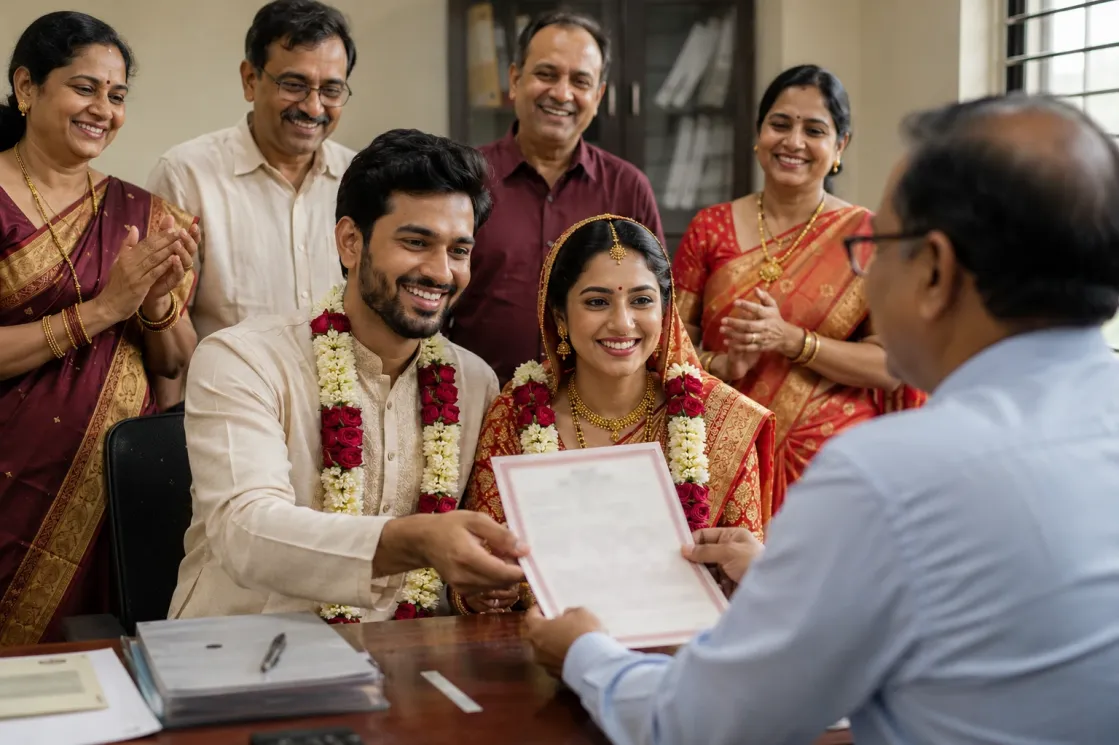
After all documents have been validated and the application process is successful, the Marriage Registrar provides the marriage registration certificate.
The marriage registration certificate acts as the official document that legally attests to marriage and is recognized by numerous bodies including government agencies and banks among others.
Why the Marriage Registration Certificate Is Important ?
A valid marriage registration certificate is commonly required for:
- Passport applications and updates
- Visa and immigration procedures
- PAN and Aadhaar updates
- Bank account nominations
- Insurance claims
- Property and inheritance matters
- Government documentation
Keep both digital and printed copies of your certificate safely for future use.
Marriage Registration Fees and Processing Time
The fees and processing time for marriage registration in India differ from one state to another.
Some states complete the process within a few working days, while others may take longer depending on document verification and appointment availability.
Check the Latest State Guidelines
Before applying, verify the following on your state's official government portal:
- Registration fee
- Processing time
- Appointment availability
- Document requirements
- Online application facility
Since these details are updated periodically, referring to official government sources helps avoid confusion.
Can Marriage Registration Be Done Online?
Yes. Many Indian states now offer online marriage registration services through their official portals.
However, even when the application is submitted online, both spouses may still need to visit the registrar's office for identity verification and document authentication.
Benefits of Online Marriage Registration
Applying online can help you:
- Save time.
- Upload documents digitally.
- Schedule appointments conveniently.
- Track your application status.
- Reduce paperwork.
Always use the official state government website while applying for register marriage online services to ensure the security of your personal information.
Marriage Registration Checklist Before You Apply
Preparing in advance can make the marriage registration process much smoother. Use this simple checklist before submitting your application.
Quick Checklist
- ✔ Both spouses meet the legal age requirement.
- ✔ Marriage has been performed according to the applicable law or ceremony.
- ✔ All identity and address proofs are ready.
- ✔ Passport-size photographs are available.
- ✔ Marriage photographs and invitation cards (if required) are available.
- ✔ Witnesses are informed and available.
- ✔ Original documents are ready for verification.
- ✔ Online application details have been reviewed carefully.
A few minutes spent checking these items can help prevent delays during registration.
Common Questions Couples Should Ask Before Registration
Many applicants are unsure about the process because rules vary slightly across different states.
Clarify These Points Before Applying
Before visiting the registrar's office, confirm:
- Which Act applies to your marriage?
- Are online appointments available?
- How many witnesses are required?
- What are the latest fees?
- How long will the certificate take?
Checking these details beforehand helps make the process more efficient.
Conclusion
Registration of your marriage is a significant milestone that ensures legal recognition of your union and ensures that the rights of both parties are safeguarded. While the ceremony marks the start of the journey for you as a couple, registering your marriage makes sure that it becomes recognized by law.
With knowledge of how to register your marriage, getting all necessary documents ready and ensuring that everything is done in the right way, it becomes easy for couples to successfully register their marriage. Since there may be variations in requirements depending on the state, it is advisable that you find out the current information from the relevant government portals.
A properly registered marriage saves you trouble with future documentation while giving you peace of mind.
Read Our More Blogs
Wedding Planning Tips: How to Plan Your Dream Wedding on a Budget
Hindu Marriage Rituals: A Complete Guide to Every Wedding Ceremony
Arranged Marriage Guide: Everything You Need to Know Before Saying Yes
Frequently Asked Questions About Marriage Registration
1. Does registration of marriage become mandatory in India?
This could be based on different state regulations and circumstances. But it would be good to have the marriage registration certificate because it proves the marriage in an official manner and can be used for various legal purposes.
2. What documentation is needed for marriage registration?
Some common documents that are needed for marriage registration include identification proof, address proof, age proof, passport size photos, photos of marriage, marriage proof, and identification proofs of witnesses.
3. Can I get my marriage registered online?
Marriage registration online facilities are available in some states for filling out applications and uploading necessary documents. However, there may be a need to appear personally at the Marriage Registrar’s office.
4. Which law do I have to use to register my marriage?
Marriages are registered as per the provisions of the Hindu Marriage Act, 1955 and Special Marriage Act, 1954, based on the religious background and nature of the marriage.
5. What is the duration for getting the marriage registration certificate?
The period varies from one state to another. It will depend on the document verification process. Applicants may refer to the latest information provided by their state government website.